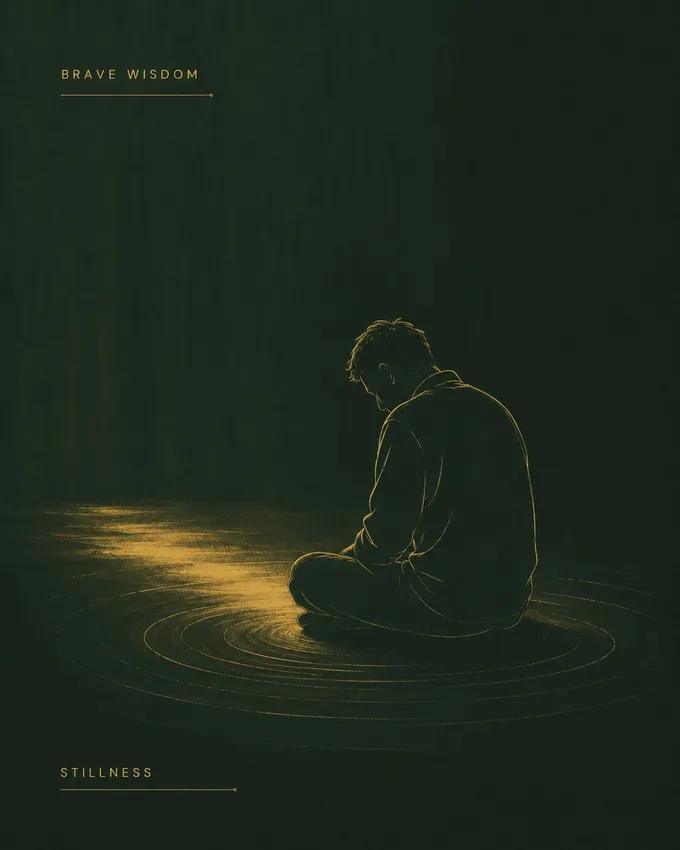
Stillness: The Place Where Performance Starts Losing Its Power
There is a version of you that only exists while you’re moving. The one who has a plan, an answer, a next step ready before anyone asks for one. That version can carry a lot of weight, for a long time, as long as it never has to stop.
You already know this. You’ve built a life that rewards the motion. Keep producing, keep responding, keep showing up capable, and nobody asks the harder question underneath. The harder question only shows up in the quiet. So you avoid the quiet. Not on purpose, exactly. It just always seems like there’s one more thing that needs you first.
Stillness threatens that version of you. Not because stillness is dangerous, but because it’s the first place you’re not performing for anyone, including yourself.
For a lot of people who have spent years being the reliable one, the capable one, the one who holds it together, slowing down doesn’t feel like rest. It feels like exposure. As long as you keep going, you don’t have to name the gap between the life people see and the life you’re actually living. You don’t have to feel what’s underneath the schedule. Motion has been doing that job for you, and it’s done it well.
But something else happens in the quiet, if you actually stay in it long enough.
Not a plan. Not a five-step process for fixing your life. Just enough silence to hear what’s already been true for a while.
You’ve been calling it discipline. Some of it might be avoidance.
That’s not an accusation. It’s just worth sitting with. The same instinct that makes you dependable can also be the thing keeping you one step ahead of a truth you’re not ready to hear. There’s a difference between a full life and a life that’s full so it doesn’t have to be still. Most people never stop long enough to tell which one they’re living.
The noise never stops on its own. Stillness has to be chosen. Nobody’s calendar clears itself out of mercy. You have to decide, on purpose, to stop long enough to hear what your life has been trying to tell you. That’s not weakness. If anything, it’s the harder work, because it takes away the one thing performance always gave you: somewhere else to look.
Sometimes the bravest thing you’ll do all week isn’t the hard conversation or the big decision. It’s sitting still long enough to let the truth catch up with you.
So here’s the question worth carrying into whatever’s next for you today.
What are you staying busy to avoid hearing?
You don’t have to answer it right now. You don’t even have to like it. Just let it sit somewhere close, because it’s not going away, and it’s not trying to hurt you. It’s trying to get your attention.
Stillness doesn’t fix anything on its own. It doesn’t rebuild your life or hand you a five-year plan. What it does is clear enough space for the next thing to speak.
Clarity is what comes next. But it can’t get a word in until you stop long enough to listen.